

The growing enthusiasm for sustainable construction in New Zealand has rightly brought straw into focus. Its potential as a carbon-sequestering, high-performance insulator is undeniable. Yet the rapid shift from traditional straw-bale building to prefabricated panels has produced a marketplace where engineering rigour and quality vary dramatically.
For discerning builders and architects, it’s vital to look beyond sustainability slogans and critically examine manufacturing methods. The concept of prefabricated straw panels is appealing, but too often the execution lacks the precision required for long-term durability—especially when artisanal methods are repackaged as industrial innovation.
The Flaw in the “Bale-in-a-Box” Approach
A fundamental flaw in many panelisation systems lies in trying to force a bulky, variable agricultural product—the straw bale—into a precision-engineered panel. This misunderstands the requirements of high-performance manufacturing. Achieving a consistent, verifiable insulation density across a panel is impossible when starting with pre-formed bales.
Agricultural bales are inherently inconsistent in shape and compaction. When inserted into a timber frame, those variations are locked into the building envelope, resulting in unpredictable thermal performance and potential air gaps.
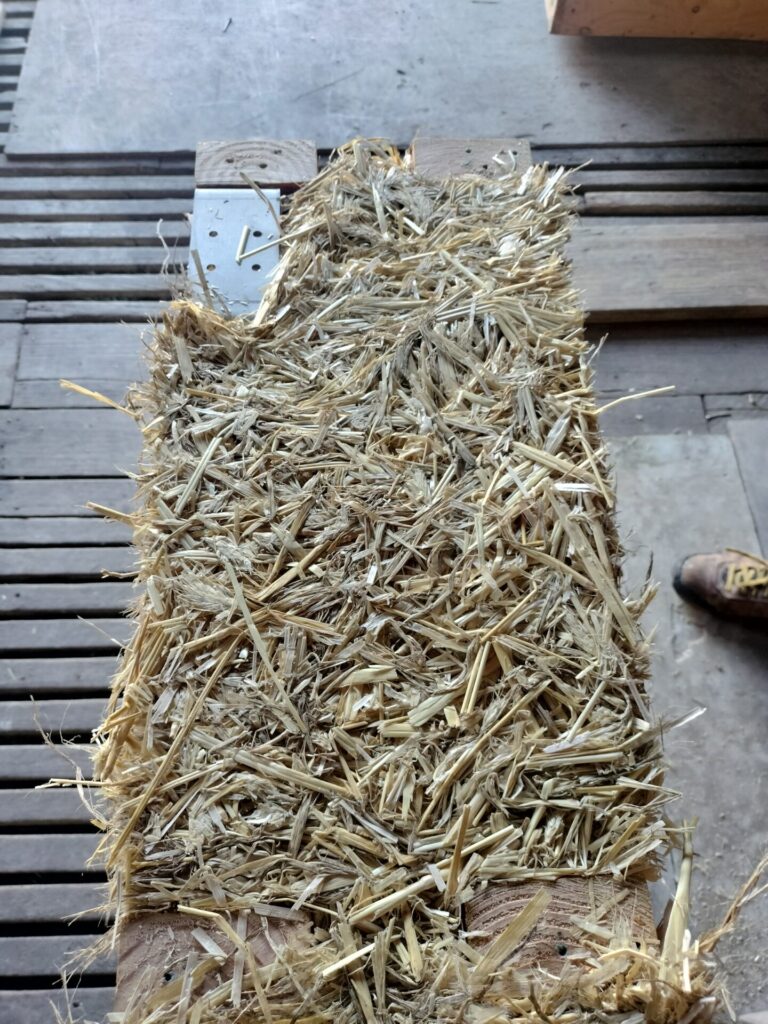
Manufacturers such as Hiberna Modular overcome this by eliminating the bale entirely. Using loose straw, precisely weighed to match the panel cavity volume, allows the target density to be achieved and guaranteed throughout the wall—control that simply isn’t possible with pre-made bales.
In “bale-in-a-box” systems, irregular bale shapes leave gaps that must be manually stuffed with loose straw—a process that’s artisanal, unverified, and dependent on human diligence. Over time, this hand-filled material settles, especially at the top of walls or in raking panels, creating voids where insulation disappears. These voids become thermal highways, accelerating heat loss and allowing convective airflow that undermines R-values and encourages moisture movement.
As the internal straw settles, plaster finishes can crack, compromising airtightness and durability. The sector must evolve from agricultural guesswork to measurable, engineered manufacturing certainty.
Invisible Shortcomings in Manufacturing
True high-performance panels rely on precision engineering that often isn’t visible in the final product. When systems prioritise low upfront cost over long-term reliability, critical elements are compromised.
New Zealand’s wet, variable climate demands specific design strategies—the “good hat and good boots” principle: generous eaves and raised foundations to protect moisture-sensitive materials. Equally essential is a breathable wall system. Vapour-permeable plasters such as lime or clay allow safe moisture migration; non-breathable renders trap moisture, guaranteeing decay.
A responsible manufacturer provides a holistic, tested solution with clear material specifications. An inferior one leaves these decisions to chance—placing performance at risk.
The Experience Gap: Proof Beyond the Plans
In New Zealand’s construction market, the true test of reliability is not marketing narrative but verifiable field performance. Innovation matters, but enthusiasm cannot replace experience. Prefabricated systems using organic materials must prove they perform not just in controlled factory settings but on unpredictable building sites.
Theoretical performance is one thing; delivering it under real-world conditions is another. This distinction becomes most visible when pursuing standards such as Certified Passive House, where airtightness, thermal bridge management, and system integration must be flawless. A track record of certified, completed buildings is the ultimate proof—not only that the panels perform as claimed, but that the team can deliver to exacting standards.

There is a crucial distinction between manufacturing a component in a factory and taking full responsibility for the execution of a project as the main contractor. Newcomers to the industry, however new their product, sometimes display a level of confidence—perhaps bordering on hubris—that can mask a fundamental lack of understanding of the complexities, liabilities, and integration challenges involved in delivering a complete, weathertight, and durable structure. The expertise required to manage these risks cannot be learned overnight or circumvented by a factory process.
Discerning clients and architects should conduct thorough due diligence on the depth of a provider’s portfolio. It is prudent to investigate not just how many projects utilise their panels, but crucially, how many projects the manufacturer has actually managed and delivered, acting as the main contractor, from concept to completion. A lack of hands-on experience in managing entire builds significantly increases the risk of integration failures on site, leaving the liability with others.
Finally, proven performance must be underpinned by continuous, independent testing. With organic materials, assumptions are unacceptable. A credible manufacturer demonstrates an ongoing commitment to empirical validation—testing, refining, and proving that long-term durability is engineered, not assumed.
In a sector increasingly defined by sustainability claims, measurable precision remains the only true marker of progress.